
Website for therapists
People considering therapy often read your website several times before getting in touch. It helps when the page calmly explains who you are, what sessions you offer and how a first meeting works, without promising anything about the outcome.
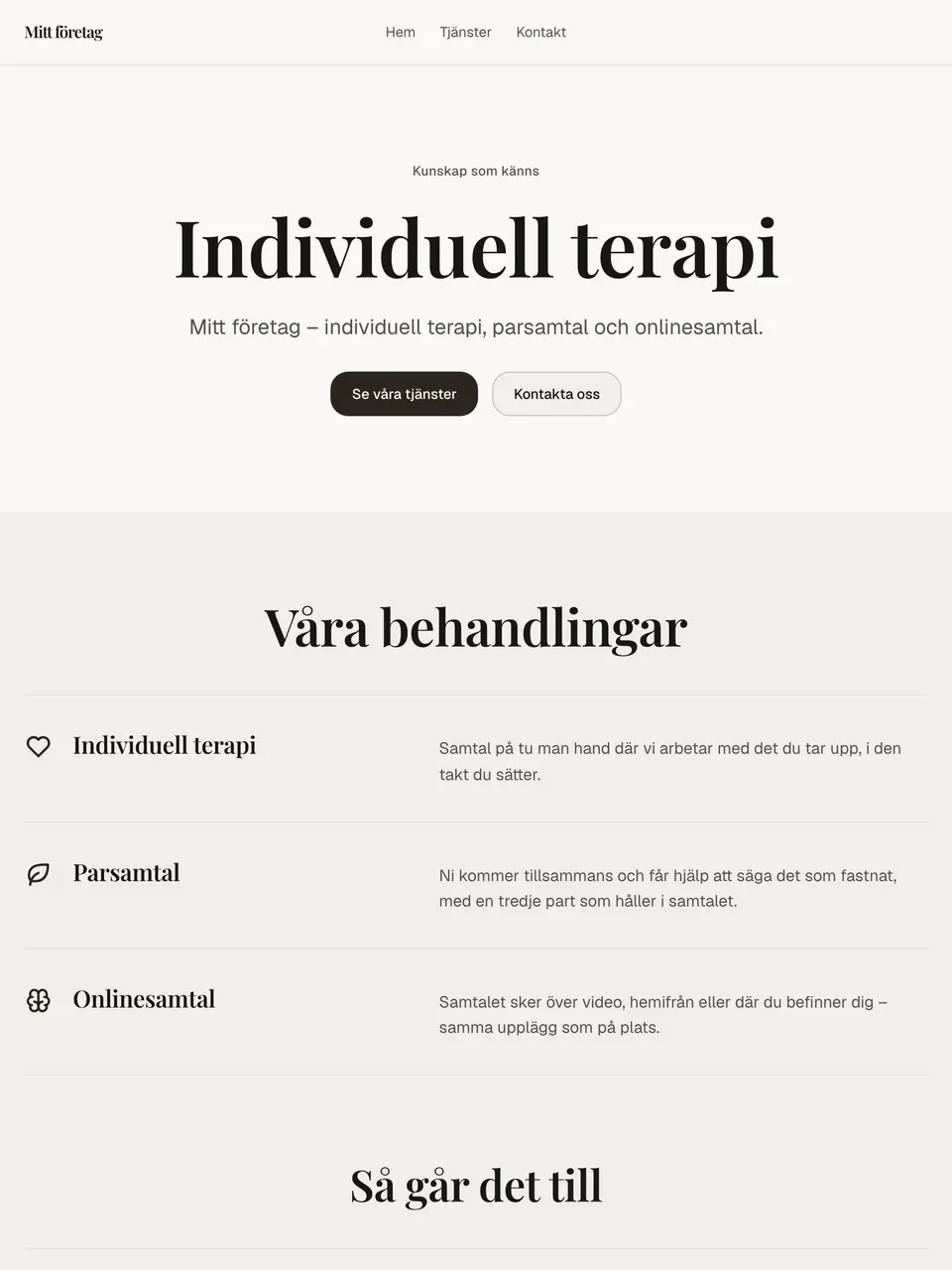
With Snabbsite you get a quiet page covering individual sessions, couples sessions and online sessions, prices and a way to book. You decide how much to share about yourself and how you work.
Keep the formats apart - they have different clients
Individual sessions, couples work and online sessions are sought out by three different people in three different situations. Someone looking for couples therapy wants to know whether you both come the first time and whether you see each person alone; someone looking for online work wants to know what platform is used and whether it works across borders. Give them their own paragraphs rather than one description that fits nobody exactly.
Say what your approach means in practice
The names of methods say little to someone who is searching. Write instead how a session usually goes with you: do you talk freely or follow a structure, is there anything to do between sessions, how many times do people usually come, and what decides when it ends. That's the description that makes someone feel she knows what she's booking.
Be clear about training, title and confidentiality
Therapist is not a protected title in every market, and people searching often know that. So write out what training you have, whether you're licensed or belong to a body with a code of ethics, whether you have supervision, and what confidentiality means with you. Be equally clear about what you don't work with and where you refer people. Honesty on that point separates you from the pages that write around it.
Price, length and cancellation should be there before anyone asks
Asking what a session costs feels, to many people, as awkward as making first contact. Write out the price per session, how long it is, whether there's a lower rate for students or a longer arrangement, how far ahead someone can cancel without paying, and whether an employer or insurer sometimes covers it. Prices come from your own list; the page never invents a figure.
Why you need a website
- Room to describe individual, couples and online sessions separately
- Prices and session length so nobody has to call and ask first
- A booking link or a contact form that goes to your own inbox
- Space to write about confidentiality and how you handle information
- A discreet, mobile-friendly page with no ads or flashing buttons
What's included
A calm, personal website that makes the first step feel safe.
- Ready-made website
- Colours & typography
- Services & pricing
- Frequently asked questions
- Contact form
- AI that knows your business
- Booking section
Frequently asked questions
No, but a short introduction usually helps. Your training, how long you have practised and how you run sessions is often enough. You choose what to include.
You can add your own section on confidentiality and how you handle personal data. Many write a few lines on the front page and more detail further down.
Yes. Link to the booking system you already use, or simply let visitors send a message if you prefer to get back to them yourself.
Cannot find your question? All questions and answers
Ready to get started?
Describe your business and we build your website in minutes. Everything stays editable afterwards.