
Website for freelancers
As a freelancer most work comes through recommendations. But whoever gets your name will google it, and they need somewhere to land that shows what you do and how to reach you.
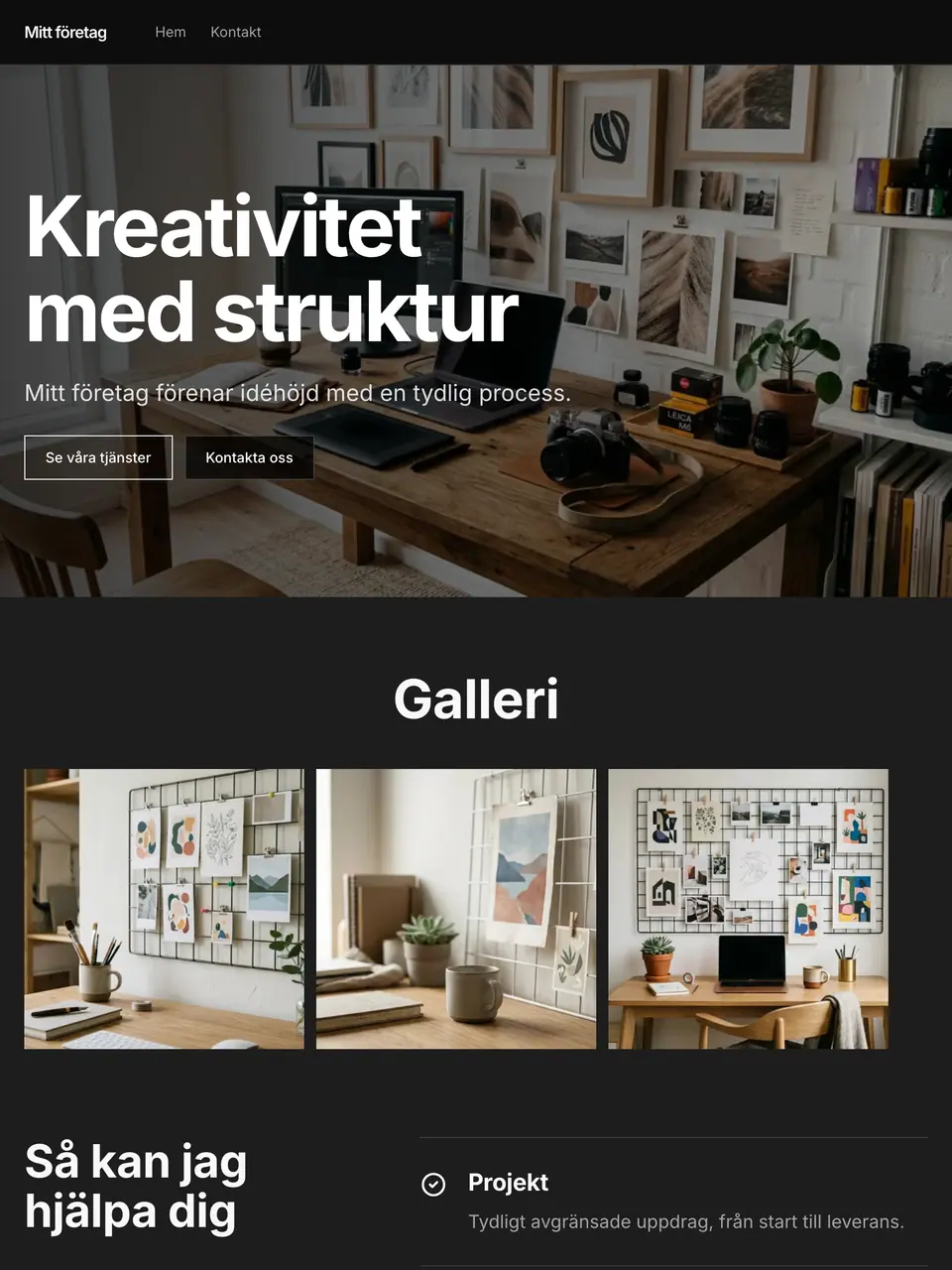
With Snabbsite you get a clean portfolio page with your work, a short introduction and a contact form. Your own domain is included, so the address looks like a business rather than a free profile.
The page exists for someone who already heard your name
Freelance work comes by recommendation, but whoever got your name googles it before writing. That means the page doesn't have to convince a stranger - it has to confirm a tip. So make sure your name, what you do and how to reach you come first and clearly, and that the page loads fast on a phone. A page that doesn't exist is how a recommendation quietly dies.
Be concrete about what a job usually costs
Freelancers avoid prices for fear of pinning themselves down, and lose the clients who don't dare ask. A range or a from-price per type of job solves it: from X for a smaller piece, a day rate for longer engagements, or a common package. Say how and when you invoice too. Prices come from your own list, and quotes and invoices go out from the same place as the website.
Show the work, not the tools
A portfolio that lists software and techniques is read by colleagues. Under each piece, write instead what the job was, what you did and what the client got out of it. If you can't name the client, write the sector and the scope. Three pieces you can say something about sell better than twelve untitled thumbnails, and they make the page searchable as well.
Say whether you're free - it's the only perishable detail
The most common question in a first email is whether you have time. Write out roughly when you could take the next job, how many hours a week you normally have free and how fast you usually reply. If you're fully booked, say so rather than going quiet. A short form asking for the job, the scope and the preferred start means the first email contains something you can answer.
Why you need a website
- A portfolio where the work speaks, without the page getting in the way
- A short introduction to what you do and who you usually work with
- A contact form instead of an email address that collects spam
- Your own domain with your name, which looks right in a signature
- Easy to update between projects, in about ten minutes
What's included
A clean portfolio page that shows your work and wins projects.
- Ready-made website
- Colours & typography
- Services & pricing
- Frequently asked questions
- Contact form
- AI that knows your business
- Portfolio/gallery
Frequently asked questions
For most freelancers, yes. A portfolio, an introduction and contact details go a long way. You can add more pages later.
Yes, as long as you are allowed to. Describe your role in the project so it is clear what you did yourself.
Yes. Connect a domain you already own, or get a new one with your name on it.
Cannot find your question? All questions and answers
Ready to get started?
Describe your business and we build your website in minutes. Everything stays editable afterwards.